Saturday, 3 December 2011

Look, Ma, No Hands!

(Originally published in my sports page column Self-Propelled
in the Dec. 4 to 10, 2011 issue of the Baguio Chronicle
--- a weekly newspaper based in Baguio City, Philippines)

YOUR Self-Propelled mourns the untimely demise of one of the most respected citizens of Baguio City, Mrs. Leonora Paraan-San Agustin.

Fr. Ranhilio Callangan Aquino perhaps said it best of Mrs. San Agustin, to quote: “(she) . . . was no softie, and she was not one to pamper us by assuring us that we were right and our persecutors wrong; she minced no words about what she thought about my arrogance and in sheer ineptitude at maintaining friendly relations with others; but I listened, harboring neither resentment nor concocting pretext because I knew she was wise, and do listen to her with attentiveness . . . she was a great teacher because of native gifts of intelligence and articulateness.”

-o0o-

PROFESSIONAL cyclists often raise their hands in victory crossing a finish line, but I’ve never had the occasion to do that.

Can you ride bike no-hands? Should you? Well, I believe it is a useful skill, even for us recreational cyclists.

Riding a bike without using your hands may be a pleasurable as well as an exciting obsession. But if proper practice is not done, it can be dangerous for you and to others.

Riding no-hands gives you the chance to do things without necessarily stopping or getting off the bike such as removing your arm warmers or vest, zipping-up your jacket, and cleaning your sunglasses. And while it probably only saves a minute, stopping interrupts your flow and pedaling momentum.

Riding no-hands takes a little technique and confidence to relinquish that control and once mastered, just becomes another practical tool in your skill set: TO USE ONLY AS NEEDED.

So, find a quiet road with no traffic or even an empty parking lot or at a nearby school campus during school breaks or a weekend. Make sure to wear your helmet and gloves in case you do take a tumble.

Pedal away at your normal pace. Don’t go slower as you need the momentum to keep the bike moving straight. Place both hands on top of the handlebar and sit square in the saddle. Now, simply push back evenly and sit up. Lift both hands at once. Don’t leave one hand on the bar as it will twist your body off center. Just sit back and keep your butt weighted in the saddle. Don’t lean forward or keep your hands hovering over the bar. Sit up straight, breathe, relax and have confidence. Remember to keep pedaling.

After a few tries, you’ll get the feel for it. Once you can get into the no-hands position easily, then you will be able to make the bike go where you want it to. Just use a minor hip/butt movement to control the bike and you can get around a rock or pothole in the road. During the execution, the bike is largely steered from your weight in the saddle and from your hips.

But if you find that you can’t keep a straight line, it may not be your technique. Your bike may be the problem. If your bike has not had regular or recent maintenance, something as simple as a wobbling (untrue) front wheel, or a misaligned fork or even a binding headset can make the bike feel squirrely.

DO NOT ride no-hands out in the open roads unless it is necessary and safe to do so.

This means waiting until the road is smooth and there’s not a lot of debris or gravel lying around that could put you into a skid. Make sure there are no gusty crosswinds, no traffic, no upcoming intersections, and nobody riding close to you. You don’t want to crash and you really don’t want to knock someone else down.

If in doubt, be safe and just stop.

Until then and have a safe ride all the time. Put on that cycling helmet each time you get on your bike. Remember: YOU CAN BEAT THE EGG WITHOUT BREAKING THE SHELL.* (SP28)*

Friday, 25 November 2011

Skyrunning goes to Mt. Ugo

(Originally published in my sports page column Self-Propelled
in the Nov. 27 to Dec. 3, 2011 issue of the Baguio Chronicle
--- a weekly newspaper based in Baguio City, Philippines.)

Your Self-Propelled lets go of his bike this week to go ‘skyrunning’.

Skyrunning. A discipline of mountain running up to or exceeding 2,000 meters where the incline exceeds 30 percent and the climbing difficulty does not exceed Grade II.

The sport comprises of a number of different disciplines from the short, steep Vertical Kilometer® to the more popular SkyRace® and SkyMarathon®. Ultra SkyMarathons are becoming increasingly popular as are short vertical SkySpeed races which includes skyscraper racing (also known as ‘vertical marathon’).

The idea of creating a sports discipline was the brainchild of Italian mountaineer Marino Giacometti, who, with a handful of fellow climbers, pioneered races on Mont Blanc and Monte Rosa in the Alps in the early ‘90s.

Just months later, with the support of a sportswear company, ‘skyrunning’ took off across the world’s mountain ranges reaching from the Alps to the Himalayas to Mount Kenya and the Mexican volcanoes.

In 1995, the Federation for Sport at Altitude or FSA was founded to address the need for rules to govern the sport and generally manage this fast-growing discipline which today counts some 200 races worldwide with around 30,000 participants from 54 countries.

The FSA was responsible for an ongoing scientific research project, probably the only studies of their kind on athletes at altitude and in the laboratory.

Today, the sport is managed by the International Skyrunning Federation, constituted in 2008 by the board and members of the FSA and founding nations. The principal aims of the ISF are the direction, regulation, promotion, development and furtherance of ‘skyrunning’ and similar multisport activities on a worldwide basis.

And here’s the good news: ‘skyrunning’ has arrived in the Cordilleras.

On February 18 next year, Mt. Ugo in Itogon, Benguet will host the very first Pilipinas Akyathlon: The Philippine International Skyrace as part of the 2012 SKYRUNNER World Series Trials. (‘akyat’ in the Pilipino vernacular means to ‘climb’.)

The 33-kilometer out-and-back race will start from the Barangay Hall of Tinongdan (779 meters above sea level) in the municipality of Itogon.

The first 1.7 kilometers is a downhill run on paved road to the start of the trail at 499 meters above sea level. From there, the race to the summit will be mostly uphill with a total elevation gain of 1,858 meters and loss of 195 meters. The scenic route offers magnificent views of the surrounding mountains, including portions of Binga and Ambuklao dams as far away as Pangasinan. It will navigate through the pine forest trails of Cayuco, Cawayan and Lusod sitios which lead to vantage points where other peaks in Benguet can be seen.

The turnaround point will be at the summit of Mt. Ugo (2,162 meters above sea level). The 16.4-kilometer route from the summit to the finish is a mirror image of the route to the summit and concludes with a 1.7-kilometer (280 meters vertically) ascend to the finish line at the Barangay Hall of Tinongdan.

Interested participants may pre-register by e-mailing their name, gender, date of birth, mobile number, and country of origin to kath@philskyrunning.com.

Registration fees are pegged at (for Philippine runners) P1,500 until November 30, 2011; P1,800 until December 31, 2011; P2,000 until January 31, 2012; and, P2,500 until February 17, 2012. Payments can be made by depositing the fee to BPI current account number 3191-0473-02 of the Philippine Skyrunning Association, Inc. Scanned deposit slip (with your name) shall be e-mailed to kath@philskyrunning.com.

On the race day itself, jeepneys will be arranged (free-of-charge) to shuttle all participants from Baguio to the starting line. Those who want to go to Tinongdan the day before may coordinate with the organizers. Camp sites are available at first-come-first-served basis.

Each runner must be self-contained and self-reliant (complete with hydration pack or fuel belt, trail food and first aid kit). The racers are highly-encouraged to bring their headgear, headlamp, and rain coat. According to the organizers, “this is a ‘green event’ and we endeavor to reduce the use of plastic, paper and other non-essential resources.”

The supplied race number bibs must be worn or pinned at the front and back of each runner. Water loading stations will be available at the start and finish line areas, 5-kilometer mark, 10-kilometer mark and the turnaround point at Mt. Ugo Summit (16.4-kilometer mark). The trail will be marked with ribbons and directional signs will be installed at appropriate junctions. Race marshals will be stationed along the course. The use of trekking poles is permitted. Bringing of mobile phone is encouraged (fully charged and with adequate load).

A ‘no-drafting rule’ (minimum 10 meters distance shall be maintained) will be enforced over the foot bridges of the course.

In case of injuries of a fellow runner or other emergencies, runners are obligated to extend appropriate help and call or text the race organizers.

More information will be posted at www.philskyrunning.com and in the Philippine Skyrunning’ Facebook account with Cheryl Bihag, Riki Adi Setiawan, Leica Lim, Suzanna Zas, Salomon Pilipinas, Johan Foray, ROX Philippines, Anto Koesharjanto, Dabobong delos Angeles and Alexander Cenzon.

Event hosts - Province of Benguet, Municipality of Itogon, and Brgy. Tinongdan; event supporters - Department of Tourism – CAR; event partners: Rope Access Services & Consulting Inc and High Angle Rescue Team of the Philippines; event sponsors: Salomon and ROX.

Until then and have a safe ride all the time. Put on that cycling helmet each time you get on your bike. Remember: YOU CAN BEAT THE EGG WITHOUT BREAKING THE SHELL.* (SP27)*

Saturday, 19 November 2011

Share the Road

(Originally published in my sports page column Self-Propelled
in the November 20 to 26, 2011 issue of the Baguio Chronicle
--- a weekly newspapers based in Baguio City, Philippines.)

SELF-Propelled remembers the victims of the infamous Maguindanao Massacre (a.k.a. Ampatuan Massacre) which killed 58, 34 of them are journalists, two years ago this week in what could be the single deadliest attack on journalists in history.

-o0o-

THE bicycle has many attractions as a form of personal transportation. It alleviates congestion, lowers air pollution, reduces obesity, increase physical fitness, does not emit climate-disrupting carbon-dioxide, and is priced within the reach of millions of people who cannot afford a car.

Practically nothing separates the biker from a hostile driver, totally unprotected, not even by the government. Unlike the biker, there is the windshield, the roll bars, the bumpers, the fenders and all those metals (sometimes including guns) to protect the driver from his fellow hostile drivers.

Such is the daily disparity on the road in a country of car culture like the Philippines and of a city like Baguio.

Drivers and cyclists: If there's even been an oil-and-water combination, this is it. We both use roads. We'd both prefer to do so without the other in the way.

But the juxtaposition puts cyclists in far greater peril than drivers. For that reason, nearly every rider would like non-pedaling motorists to know how vulnerable they are. And, yes, riders also need to take responsibility for their own safety, but a few simple tips for drivers will make the roads safer for everyone. You may think that you, as a seasoned cyclist, already know how to coexist with bikes when you drive, but a refresher can't hurt.

SLOW PASSING SAVES LIVES

A study in the UK showed that a pedestrian is eight times more likely to be killed by a car when struck at 30 mph than at 20 mph. The obvious implication is that a cyclist hit by a car has a much greater chance of survival if that vehicle is passing at a cautious speed. Pass efficiently, at perhaps 25 to 30 mph, if the rider is going 15 mph. You may want to speed up because a car from the opposite direction is coming. Well, that means it's not the right time to pass safely. Give way to the biker.

Fifteen states have settled on 3 feet as the motorist's minimum legal distance for safely passing cyclists. (NOTE: We do not have these things in the Philippines, Baguio in particular, to discuss, so we might as well discuss what they have in other countries.)

Gary Brustin, a California cycling attorney, is a huge proponent of the rule, saying it gives drivers the clear, workable guideline they need. "The unsafe, too-close pass easily turns into a rear-end accident, the number one cause of cycling fatalities we see here," he says. He adds that if your car is brushing past cyclists with only a foot to spare, the slightest leftward move by the cyclist can mean a collision.

While Brustin lobbied unsuccessfully for a 3-foot rule in his state, a bipartisan effort helped lead governor Arnold Schwarzenegger to sign California's Complete Streets Act in 2008, requiring local governments and planners to safely accommodate all users, including cyclists. A push for a nationwide standard is now taking place in both houses of Congress.

Car crashes linked to cell-phone use have led 20 states to ban driver texting, and six currently require hands-free devices for calls. (Whatever happened to this proposition when it was initially discussed at the Baguio City Council some 5 months ago?)

But even with hands-free devices, driving and talking on the phone makes you dangerous to everyone on the road. In one study, psychologists at the Center for Cognitive Brain Imaging at Carnegie Mellon University, in Pittsburgh, had subjects "drive" simulators while responding to spoken questions.

Subjects strayed from their lanes, an obvious hazard to cyclists, and their brains (scanned by a magnetic-resonance imaging machine) showed a 37 percent drop in activity in the parietal lobe, the region tied to driving.

RIDE SINGLE FILE WHEN POSSIBLE

Amanda Eichstaedt, a cycling instructor who chairs the League of American Bicyclists' National Legal Defense Committee, says too many cyclists ignore the safety hazards of riding two-up when cars are following or on busy roads.

Use hand signals to indicate your intentions or let drivers know they should pass. It shows you're aware of their presence and gives them more information.

Eye contact with drivers announces your presence. Garmin-Transitions pro Dave Zabriskie says it also reminds drivers that you are a living, breathing person, not a rolling obstacle.

Thirty-eight percent of cycling fatalities in 2008 took place at intersections. Before initiating a turn, drivers need to focus attention on their rear-and side-view mirrors. Turning right? Look for cyclists along the curb who may be going straight.

A few decades ago it was standard practice to count "one, one thousand; two, one thousand," to figure out how closely to follow the car ahead of you. If you reach a landmark two seconds after the vehicle in front of you, you can safely brake in time to avoid a fender bender. Today, car brakes are more effective, and the two-second rule might seem like overkill. It's not. Safety researchers say it takes roughly 0.75 seconds to recognize a stopping situation and another 0.75 seconds to hit the brakes, and that leaves only 0.5 seconds of actual braking.

That makes it imperative that you give cyclists at least as much time as you'd give another vehicle ---and remember that even tapping a cyclist with your 4,000-pound car could kill him.

Until then and have a safe ride all the time. Put on that cycling helmet each time you get on your bike. Remember: YOU CAN BEAT THE EGG WITHOUT BREAKING THE SHELL.* (SP26)*

Saturday, 12 November 2011

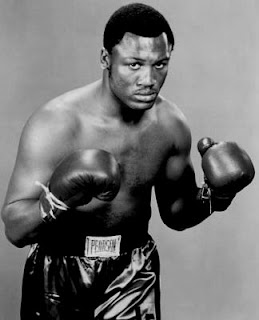
Goodbye, Smokin' Joe!

(Originally published in my sports page column Self-Propelled in the Nov. 13-19, 2011 issue of the Baguio Chronicle --- a weekly newspaper based in Baguio City, Philippines.)

I GET off my bike this week in tribute to one of the greatest athletes/boxers of all time: SMOKIN’ JOE FRAZIER.

More known as the first man to beat Muhammad Ali (Cassius Clay) in March 1971 at the Madison Square Garden, Smokin’ Joe passed away last November 7 after battling liver cancer for two months.

He was 67 years old and left behind a professional boxing record of 37 fights --- 32 wins (27 by knockouts; 4 losses and 1 draw).

Born Joseph William Frazier in Beaufort, South Carolina on January 12, 1944, Frazier took up boxing early after watching weekly fights on the black and white television on his family's small farm. He was a top amateur for several years, and became the only American fighter to win a gold medal in the 1964 Olympics in Tokyo despite fighting in the final bout with an injured left thumb.

Frazier's style was often compared to that of Henry Armstrong and occasionally Rocky Marciano. He was dependent on bobbing, weaving, grunting, snorting as he grimaced with all out aggression wearing down his opponents with relentless pressure. His best known punch was a powerful left hook, which accounted for most of his knockouts.

After turning pro in 1965, Frazier quickly became known for his punching power, stopping his first 11 opponents. Within three years, he was fighting world-class opposition and, on February 16, 1970, beat Jimmy Ellis at the Madison Square Garden to win the heavyweight title that he would hold for more than two years.

On March 8, 1971, at Madison Square Garden, Frazier and Ali met in the first of their three bouts which was widely called the "Fight of the Century" in pre-bout publicity and the press feeding frenzy with a worldwide television audience and an in-house audience that included luminaries such as Frank Sinatra (as a photographer for Life magazine to get a ringside seat), comedian Woody Allen, singer Diana Ross, and actors Dustin Hoffman and Burt Lancaster (who served as "color commentator" with fight announcer Don Dunphy).

Newspaper accounts say that several factors came together for Frazier in that fight. He was 27 years old and at his lifetime peak boxing-wise, physically and mentally, while Ali, 29, was coming back from a three-year absence (after being stripped of his professional boxing license and his title for refusing military draft) but had kept in training, taking on Frazier three months after a bruising battle with Oscar Bonavena, whom Ali had defeated by a TKO in 15.

Joe did his 'homework' training with famed coach Eddie Futch, who had developed a strategy based on Ali's tendency to throw the right-hand uppercut from a straight standing position after dropping the hand in preparation to throw it with force. Futch instructed Frazier to watch Ali's right hand and, at the moment Ali dropped it, to throw a left hook at the spot where they knew Ali's face would be a second later. Frazier's major staggering of Ali in the 11th round and his knock-down of Ali in the 15th were both executed precisely in this way.

In a brutally competitive contest, Frazier lost a number of early rounds but took Ali's combinations without backing down. As Ali started to slow in the middle rounds, Frazier came on strong, landing hard shots to the body as well as the powerful left hooks to the head.

Consequently, Frazier won a clear, 15-round, unanimous decision. Ali was taken to the hospital immediately after the fight to have his badly swollen jaw x-rayed, and Frazier spent time in the hospital during the ensuing month, the exertions of the fight having been exacerbated by his existing health problems, such as hypertension and a kidney infection. Sometime later he fought a 3-round exhibition against Cleveland Williams.

In 1972, Frazier successfully defended the title twice, beating Terry Daniels and Ron Stander, both by knockout, in the fourth and fifth rounds, respectively.

It was his fights with Ali, though, that would define Frazier. Though Ali was gracious in defeat in the first fight, he was as vicious with his words as he was with his punches in promoting all three fights --- and he never missed a chance to get a jab in at Frazier.

Frazier's second fight against Ali took place on January 28, 1974, in New York City. In contrast to their previous meeting, the bout was a non-title fight, with Ali winning a clear 12-round unanimous decision.

Five months later, Frazier again battled Jerry Quarry in Madison Square Garden, with a wicked left hook to the ribs by Frazier ending the fight in the fifth round.

In March 1975, Frazier again fought Jimmy Ellis, the man from whom he had originally taken the WBA title in Australia, knocking him out again in nine rounds. The win again established him as the number one heavyweight challenger for the title that was now held by Ali, following an eighth-round knockout of George Foreman in the famous “The Rumble in the Jungle” in October 1974.

Ali and Frazier met for the third and final time at the Araneta Coliseum on October 1, 1975 in what was known as the “Thrilla in Manila” where took every opportunity to mock Frazier, again calling him The Gorilla, and generally trying to irritate him.

The “Thrilla in Manila” was the third and final famous boxing match between Muhammad Ali and Joe Frazier and was often ranked as one of the greatest fights of 20th century boxing, and is the climax to the bitter rivalry between Ali and Frazier over who was the legitimate Heavyweight Champion.

That situation came about after Ali was stripped of the title over his refusal to join the armed forces when drafted during the Vietnam Was. Some years later, Frazier petitioned President Nixon to restore Ali's right to box, thereby bringing about the so called Fight of the Century between two undisputed heavyweight champions in 1971.

During the whole period from before their first fight to their last face-off in Manila, Ali had used his wit, sharp tongue, and position with the press to take characteristic verbal pot shots at Frazier (as was his practice with all opponents and which made good copy and controversy) but these became particularly intense, controversial and at times ugly and this verbal battery heated the rivalry into new territory.

The fight proved far more action-filled than the previous encounter and was a punishing display on both sides under oppressively hot conditions. During the course of the fight, Ali said to Frazier, "They said you were through, Joe." Frazier's reply quickly followed: "They lied, pretty boy." After 14 grueling rounds, Eddie Futch stopped the fight after Frazier was determined to finish the fight despite both eyes being swollen shut. Ali won the battle, but said afterward that it was the closest he ever felt to death.

Frazier lost his undefeated record of 29–0 and his world championship in the hands of the unbeaten George Foreman on January 22, 1973, in Kingston, Jamaica. Despite Frazier being the overall favorite, Foreman towered 4" over the shorter, more compact champion, and soon dominated the brief bout. Two minutes into the first round, Frazier was knocked down. After being knocked down a sixth time, the referee stopped the contest. It was the first two knockdowns that were decisive.

He retired in 1976 following a second loss to Foreman. He made a comeback in 1981, fighting just once, before retiring for good. The International Boxing Research Organization (IBRO) rates Frazier among the ten greatest heavyweights of all time. He is an inductee of both the International Boxing Hall of Fame and the World Boxing Hall of Fame.*

Saturday, 5 November 2011

Bike Crash, Road Rash and Abrasion Wound Management

(Originally published in my Self-Propelled column in the sports page section of the November 6-12, 2011 issue of the Baguio Chronicle --- a weekly newspaper based in Baguio City, Philippines.)

WHAT goes up must come down. Falls, spills, and crashes are facts in biking. Even the most experienced riders and the world’s best professional riders go down.

Usually the damage is not so bad but you will almost always have to deal with some level of road rash from the friction of your skin sliding along pavement, crushed stone, or even a mountain bike trail.

Recognizing the 3 degrees of road rash.

1st Degree: Reddened surface only, unbroken skin layer.

2nd Degree: Surface of skin is broken but with a good amount of healthy tissue under and surrounding the wound. This will allow the skin cells to regenerate and the wound to eventually heal.

3rd Degree: Skin is entirely removed and possibly exposing underlying tissue such as bone, underlying fat, tendons, etc.

*CAUTION: ALWAYS seek immediate medical attention for 3rd degree road rash or if ever you are in doubt about any of your wounds or your ability to properly look after them on your own. DO NOT attempt to treat yourself.

Here are my suggestions for a simple, safe, and effective method of treatment for basic 1st and 2nd degree road rash:

STAGE 1: Initial Cleaning (usually performed at the scene of the accident)

Spray or squirt saline solution or clean water all over the wound and pat dry with a gauze (you can rub a little but not vigorously or you may cause more damage)

Hydrogen peroxide, alcohol, and iodine Not only add unnecessary sting but they can cause cellular damage that delays healing or leaves additional scarring.

Remove only the very loose debris such as rocks, glass, wood splinters, etc. Save the rest of the cleaning for the shower or bath as soon as you can get to one. Sooner is definitely better.

Dab on a topical antibiotic cream like Polysporin, Neosporin, or Fucidin and cover with a sterile dressing until you can get home (or to the hospital emergency if required) for further treatment.


STAGE 2: Comprehensive Cleaning (usually at home in the bath or shower)

Get in the shower or bath, soak the wounds with warm water (not hot, unnecessary pain), and rub gently with a soft soapy cloth or just your hands. Repeat this until the wound looks mostly clean and free of debris.

Pat dry with a clean towel or gauze.

(If there is still some small debris that appears stuck like rocks or large grains of sand, and you can get an edge of it, you can try removing these one by one with sterilized tweezers.)

Spray or squirt saline solution on wounds again and dab dry, always with sterile pads or gauze.

Apply antibiotic cream and cover with sterile bandage. Note: In place of traditional sterile wound dressings, there are some breathable dressings on the market made by 3M, Smith & Nephew, and some others. Consult your doctor or pharmacist for proper use of these alternative dressings.

Repeat Stage 2 steps at least twice daily for a few days and then at least once a day for another week or so.

Keep the wound as clean as possible and always covered, especially when outdoors to prevent exposure to the sun in order to minimize scarring and skin discoloration. Always monitor yourself for any signs of infection. The wound may be infected if it is red, hot, swollen, and unusually painful, smells bad or has pus.

Signs of a systemic infection can be serious and you should seek immediate medical attention if you develop fever, change in appetite, red streaks/lines radiating out in any direction from any wound site, lymph nodes become swollen or tender, and if for any reason you are in doubt or generally do not feel well.

After doctoring yourself, check your bike before riding away from the scene of the accident. Even if everything looks intact after a crash, you might still be a catastrophe waiting to happen. A hairline crack can grow, a dent can buckle, and a bend can break and the only way to ride safely again is to do a thorough post-crash inspection.

INSTRUCTIONS:

• Lift the front end of your bike and spin the front wheel. Look to see that the wheel has no wobble and is not rubbing against your brakes. Lift the back of the bike and spin the rear wheel to check for similar signs.

• Check that you didn't bend your handlebar. Make sure your handlebars have not repositioned themselves in the fall. If they are twisted, use an Allen wrench on the headset to reset them.

• Squeeze the front brake and rock the bike fore and aft to feel for play in the headset. On a mountain bike, check for looseness where the fork sliders enter the lowers. If anything is amiss, steering and balance will be out of line.

• Check spokes to be sure that none has de-tensioned.

• Squeeze both brake levers to ensure that the pads are centered on and still contacting the rim. Adjust the brakes if the wheel is slightly out of tune and get the wheel fixed when you get home.

• Check that your chain is still on the front and back chain rings. If it has slipped off, grab the chain and place it back on a chain ring.

• Look to see if both tires are full of air.

• Re-adjust your bike seat if it is askew.

• Ride your bike slowly at first, listening and feeling for any out of tune parts.

• Always have a qualified mechanic check out your bike after a crash. He will be able to spot problems you may not have noticed.

• Do not try to ride a damaged bicycle. It may be unsafe.

While helmets can do amazing things to protect you from head injuries, they are not rated to withstand a crash after being damaged. If your helmet is damaged in a crash, it is important that you replace it immediately.

If you aren’t sure if your helmet has been damaged, some companies (like Giro) offer free inspection of your helmet, and will recommend whether or not it should be replaced. If your helmet’s company does not offer this service, it is a good rule of thumb to replace the helmet if you have any doubts about whether or not it is damaged. Most companies recommend replacing your helmet every two to three years even if you haven’t crashed, because the materials helmets are made of will eventually break down, and helmets often suffer wear and tear from being banged around or dropped in everyday use.

Until then and have a safe ride all the time. The best way to void crashes is not to ride beyond your limits. Put on that cycling helmet each time you get on your bike. Remember: YOU CAN BEAT THE EGG WITHOUT BREAKING THE SHELL.* (SP24)

Sunday, 30 October 2011

Top 10 Best Road Cycle Racers of All Time

(Originally published in my sports page column Self-Propelled in the October 30 to November 5, 2011 issue of the Baguio Chronicle --- a weekly newspaper based in Baguio City, Philippines.)

THIS is perhaps the widely-accepted unofficial list of the Top Ten best road bicycle racers of all time.

The criteria are that the bicycle racers have not only performed well in the three big stage races --- Tour de France, Giro d’Italia and Vuelta a España --- but also in the minor stage races such as Tour de Suisse, Paris-Nice and Dauphiné Libéré and the classics like Paris-Roubaix and Liège-Bastogne-Liège.

They are:

Number 10:

Jan Ullrich, a German, was born in 1973. He won the Tour de France in 1997, the white jersey (known in the Tour de France as the maillot blanc and is awarded to the best-placed rider under 26 years of age) in 1996, 1997 and 1998, and he has 5 second places in the Tour de France which earned him the nickname The Eternal Second. Ullrich has also won Vuelta a España in 1999 and the Tour de Suisse in 2004 and 2006. Other notable wins are the World Time Trial Champion in 1999 and 2001 and the Olympic Road Race in 2000.

Ullrich is a powerful bicycle racer with a soft, athletic style, but he often got out of shape during the off-season and had problems losing the extra weight before racing the big races.

Number 9:

The American Lance Armstrong holds the record of most victories in Tour de France with his 7 consecutive wins. Armstrong also won the 2001 Tour de Suisse and the World Cycling Championship in 1993. This earns him a place on this list, but because Armstrong never impressed in the Giro D’Italia, the Vuelta a España or the Classics.

Number 8:

Miguel Indurain was born in Spain in 1964. He has won the Tour de France five times in a row and the Giro D’Italia two times in a row. He has also won the Olympic Time-Trial Championship in 1996 and the World Time-Trial Championship in 1995, as well as two wins in both Dauphiné Libéré and Paris-Nice.

Indurain was relatively big compared to other professional riders --- 1.88 m (6 ft 2 in) and 80 kg (176 lbs) --- which earned him the nickname Miguelón, meaning “Big Mig”.

At the top of his career, Miguel Indurain had a physique that was not only superior when compared to average people, but also when compared to his fellow athletes. His blood circulation had the ability to circulate 7 liters of blood around his body per minute, compared to the average amount of 3n to 4 liters of an ordinary person and the 5 to 6 liters of his fellow riders.

Number 7:

Fausto Coppi was born in Italy in 1919. He won the Tour de France twice, in 1949 and 1952, and the Giro D’Italia five times in 1940, 1947, 1949, 1952 and 1953. He also won the World Championship in 1953, the Giro di Lombardia in 1946, 1947, 1948, 1949 and 1954, the Milan-Sanremo in 1946, 1948 and 1949, and the Paris-Roubaix and the La Flèche Wallonne in 1950.

Number 6:

Felice Gimondi was born in Italy in 1942. In 1968 Gimondi was nicknamed The Phoenix after winning the Vuelta a España, this victory made him the second rider after Jacques Anquetil to win all three big stage races. He is one of only five riders to ever win all three. Gimondi won the Tour de France in 1965, the Giro D’Italia in 1967, 1969 and 1973 and the Vuelta a España in 1968.

Gimondi also won Paris-Roubaix in 1966 and the World Road Cycling Championship in 1973.

Number 5:

Gino Bartali was born in Italy on 1914. He has won the Tour de France twice, in 1938 and 1948, both times also winning the mountain competition, and the Giro D’Italia three times in 1936, 1937 and 1946, also here he won the mountain competition all three times. Bartali also won the Tour de Suisse in 1946 and 1947.

Bartali was a good climber and a pioneer of derailleur gears. His style was considered unconventional. He rarely danced on the pedals and often stayed in the saddle throughout a 15 km climb. When others attacked, he stayed in the saddle but changed up gear, to a sprocket three teeth smaller. He rode smoothly on mountains but every now and then freewheeled, always with his right foot lowered with his weight on it. Then a second or two later he would start pedaling again.

Number 4:

Séan Kelly was born in Ireland in 1956 and became one the most successful riders of the 80s and the best Classics rider of all times. His wins include the Vuelta a España in 1988, 4 point class wins in both the Tour de France and the Giro D’Italia, seven consecutive win in Paris-Nice from 1982 to 1988, and two wins in Tour de Suisse, Paris-Roubaix and Liège-Bastogne-Liége.

Number 3:

Jacques Anquetil was born in France in 1934. He has won the Tour de France five times, in 1957 and 1961-1964, the Giro D’Italia twice in 1960 and 1964, the Vuelta a España in 1936 and the Liège-Bastogne-Liège in 1966. Anquetil also holds several records:

• He was the first to the Tour de France five times
• He was the first to win all three big stage races
• He was the first French rider to win the Giro D’Italia
• He was the first French rider to wear the yellow jersey in the Tour de France form the first day to the last

Number 2:

Bernard Hinault was born in France in 1954, and is one of only five riders to have won all three big stage races, and the only to have won each more than once. Hinault is the only rider ever to have finished either first or second in each Tour de France he finished. He won the Tour de France in 1978, 1979, 1981, 1982 and 1985, the Giro D’Italia in 1980, 1982 and 1985 and the Vuelta a España in 1978 and 1983.

Among Hinault many other victories are Paris-Roubaix in 1981, Liège-Bastogne-Liège in 1977 and 1980 and the World Road Cycling Championship in 1980.

Number 1:

Eddy Merckx was born in Belgium in 1945 and became the best road bicycle racer the world has ever seen. He won the Tour de France five times in 1969, 1970, 1971, 1972 and 1974, the Giro D’Italia five times in 1968, 1970, 1972, 1973 and 1974 and the Vuelta a España once in 1973. Merckx also won the Tour de Suisse once, Paris-Nice 3 times, Dauphné-Libéré once, Paris-Roubaix three times, Liège-Bastogne-Liége five times and the World Road Race Championship three times.

Merckx is also one of only five riders to win all three big stage races during their career, the four others are Jacques Anquetil, Felice Gimondi, Bernard Hinault and Alberto Contador.*

Friday, 21 October 2011

The Tour Through The Years*

(*Originally published in my sports page column Self-Propelled in the October 23 to 29, 2011 issue of the Baguio Chronicle --- a weekly newspaper based in Baguio City, Philippines.)

LE Tour de Filipinas or the Tour of the Philippines is held each year from April to May each year. Its previous names included the Tour of Luzon, Marlboro Tour, Tour of Calabarzon (2002), Tour Pilipinas and Padyak Pinoy, before carrying the current name.

In 1955, the Tour was launched as a four-stage race from Manila to Vigan race won by Antonio Arzala. A year later, the race was renamed as the Tour of Luzon and carried the name until 1976 (there were no tours held in 1968, 1970, 1971 and 1972).

Among the prominent riders include Pangasinan riders Cornelio Padilla, Jr. and Jesus Garcia, who were two-time Tour champions along with Jose Sumalde of Catanduanes.

In 1977, a rift within the Professional Cycling Association of the Philippines or PCAP led to a split of two tours during the said year. The Padyak Pinoy website says that the event organized by Geruncio Lacuesta is recognized on their official list. The tour's name ended by 1978 as Marlboro entered the scene.

By 1979, Marlboro became the official sponsor of the Tour and the event was named as Marlboro Tour, a name that is commonly familiar to ardent racers and fans.

During these times, the Tour expanded its routes, by including cities from Visayas in the leg, with the final laps regularly held at the Quirino Grandstand in Manila.

From 1997-1998, the Tour allowed riders from Asia to compete in the event and was sanctioned by the UCI. It also led to Wong Kam Po of Hong Kong to become the first non-Filipino to win the event in 1997, after overtaking 1996 winner Victor Espiritu for the lead in the latter stages.

The format used for the teams are based on provinces with the National Team included in the race. It was also the same format when Asian riders participated in the event beginning in 1997.

In 1999, Marlboro backed out as sponsor which proved to be a devastating blow to the organizers. Because of this, there were no tours held from 1999 to 2001. To compensate for the loss of the so-called "Summer Cycling Spectacle", other groups formed mini-races during the summer.

In 2002, the Tour was revived after Airfreight 2100 of Bert Lina and Lito Alvarez financed the tour. A four-leg race was held in late-May known as Tour of Calabarzon won by Santy Barnachea. A year later, the tour was renamed as Tour Pilipinas and held a 17-leg race, the longest since 1998. The tour was won by Arnel Quirimit of Pangasinan.

Ryan Tanguilig won in 2004 in a 10-stage tour. In 2005, the tour was renamed as the Golden Tour 50 @50, honoring the 50th anniversary of the Tour. 1998 champion Warren Davadilla, who won the last edition of the Marlboro, was the champion.

In 2006, several disputes within the National Cycling Association led to a short eight stage event dubbed with the current Padyak Pinoy name which was won by Barnachea.

The Champions:

1955 Manila to Vigan (4 laps; 418 km) Antonio Arzala
1956 Tour of Luzon (5 laps; 1,057 km) Antonio Arzala (33:45:08)
1957 Tour of Luzon (6 laps; 1,155 km) Rufino Gabot (51:45:22)
1958 Tour of Luzon (7 laps; 1,517 km) Mamerto Eden (61:14:08)
1959 Tour of Luzon (8 laps; 1,634 km) Antonio Arzala (59:44:50)
1960 Tour of Luzon (9 laps; 1,648 km) Rodrigo Abaquita (57:51:02)
1961 Tour of Luzon (12 laps; 2,167 km) Jose Moring, Jr. (59:44:50)
1962 Tour of Luzon (12 laps; 1,870.23 km) Edmundo de Guzman (61:04:50)
1963 Tour of Luzon (14 laps; 2,334.38 km) Gonzalo Recodos (78:27:54)
1964 Tour of Luzon (14 laps; 1,967.6 km) Jose Sumalde (60:22:09)
1965 Tour of Luzon (14 laps; 2,049.31 km) Jose Sumalde (65:13:19)
1966 Tour of Luzon (15 laps; 1,999.82 km) Cornelio Padilla, Jr. (60:45:31)
1967 Tour of Luzon (8 laps; 1,634 km) Cornelio Padilla, Jr. (70:34:57)
1968 NO TOUR WAS HELD
1969 Tour ng Pilipinas (10 laps; 1,208.4 km) Domingo Quilban (37:50:29)
1970 NO TOUR WAS HELD
1971 NO TOUR WAS HELD
1972 NO TOUR WAS HELD
1973 Tour of Luzon (10 laps; 1,214 km) Jesus Garcia, Jr. (34:38:38)
1974 Tour of Luzon-Visayas (18 laps; 2,540.95 km) Teodorico Rimarim (78:35:19)
1975 Tour of Luzon (15 laps; 2,207.87 km) Samson Etrata (66:18:48.6)
1976 Tour of Luzon (6 laps; 2,200 km) Modesto Bonzo (66:31:10.4)
1977 Tour ng Pilipinas (24 laps; 4,000 km) Manuel Reynante (106:57:20.1)
1977 Marlboro Tour (3 laps; 1,697 km) Jesus Garcia (55:37:52.8)
1978 Perk Speed Tour (3 laps; 405.8 km) Rumin Salamante (10:11:10)
1979 Marlboro Tour (11 laps; 1,900 km) Paquito Rivas (60:01:06.4)
1980 Tour of the Phils. (21 laps; 2,780 km) Manuel Reynante (83:08:00.84)
1981 Tour of the Phils. (21 laps; 3,058.81 km) Jacinto Sicam (87:25:43.99)
1982 Marlboro Tour (15 laps; 2,192 km) Jacinto Sicam (61:29:17.57)
1983 Marlboro Tour (14 laps; 2,313 km) Romeo Bonzo (63:54:31:94)
1984 Marlboro Tour (14 laps; 2,464 km) Ruben Cariño (68:08:49.46)
1985 Marlboro Tour (21 laps; 3,668.97 kms.) Pepito Calip (97:04:42.04)
1986 Marlboro Tour (10 laps; 2,900 km) Rolando Pagnanawon (77:39:53.14)
1987 Marlboro Tour (17 laps; 3,282 km) Reynaldo Dequito (88:06:50.88)
1988 Marlboro Tour (17 laps; 3,544.53 km) Amando Catalan (94:44:03.92)
1989 Marlboro Tour (18 laps; 3,539.47 km) Gerardo Igos (95:40:23.79)
1990 Marlboro Tour (18 laps; 3,317.42 km) Manuel Buenaventura (95:58:38.8)
1991 Marlboro Tour (17 laps; 2,373.61 km) Bernardo Llentada (63:33:17.73)
1992 Marlboro Tour (17 laps; 2,731 km) Renato Dolosa (71:21:49.2)
1993 Marlboro Tour (21 laps; 3,480 km) Carlo Guieb (91:41:54.62)
1994 Marlboro Tour (21 stages; 3,563 km) Carlo Guieb (91:24:13.33)
1995 Marlboro Tour (19 stages; 3,280.33 km) Renato Dolosa (83:43:39.54)
1996 Marlboro Tour (19 stages; 3,257.29 km) Victor Espiritu (80:50:46.24)
1997 Marboro Tour (16 stages; 2,472 km) Wong Kam Po (Hong Kong) 62:06:28
1998 Marlboro Centennial Tour (16 stages; 2,494 km) Warren Davadilla (64:58:57)
1991 NO TOUR WAS HELD
2000 NO TOUR WAS HELD
2001 NO TOUR WAS HELD
2002 FedEx Tour of CALABARZON (4 stages; 517.7 km) Santy Barnachea (12:41:13)
2003 Air21 Tour Pilipinas (15 stages; 2,849.8 km) Arnel Quirimit (55:29:20.63)
2004 Air 21 Tour Pilipinas (17 stages; 2,849 km) Ryan Tanguilig) (70:28:59)
2005 Golden Tour 50@50 (10 stages; 1,492 km) Warren Davadilla (37:20:55)
2006 Padyak Pinoy (8 stages; 1,219.4 km) Santy Barnachea (31:10:03)
2007 Padyak Pinoy (10 stages;1,500 km) Victor Espiritu (33:02:38)
2008 NO TOUR WAS HELD
2009 NO TOUR WAS HELD
2010 Le Tour de Filipinas (4 stages) David McCann (Ireland)
2011 Le Tour de Filipinas (4 stages) Rahim Emami (Iran)